
When someone dies, one of the hardest things for family friends is knowing how to show up. People want to be kind. They want to say something meaningful. They want to help. But grief can make even simple interactions feel awkward, and many people worry they will say the wrong thing or do the wrong thing.
The good news is that you do not need perfect words. You do not need a long speech, a deep insight, or a polished message. In most cases, what grieving families need most is something much simpler: kindness, calm, and practical support. A thoughtful message, a small act of help, or a quiet reminder that they are not alone can mean far more than people realize.
For family friends, the goal is not to fix grief or force comfort. It is to make a painful moment feel a little less lonely and a little less overwhelming.
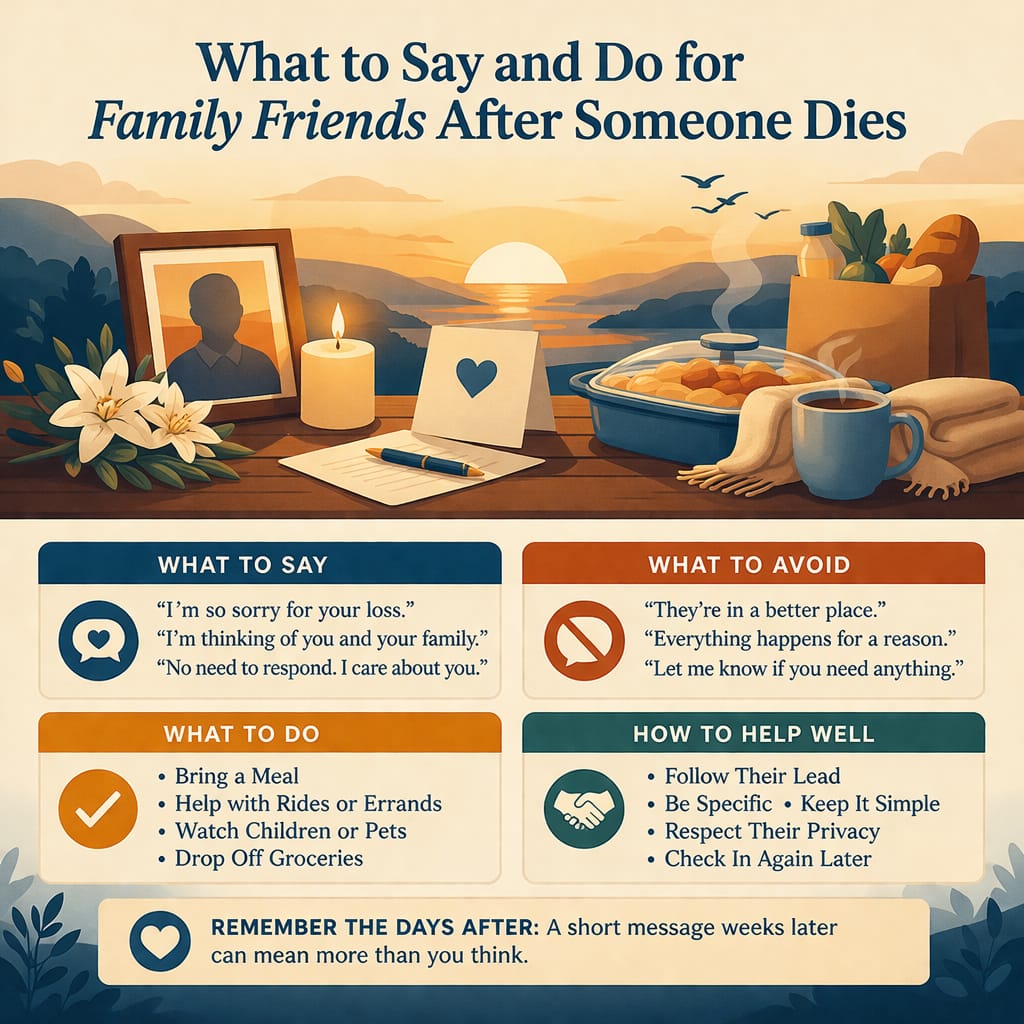
What to Say
When you reach out after a death, the best approach is usually the simplest one. Keep your message sincere, brief, and human. Acknowledge the loss, express care, and, if appropriate, share something true about the person who died.
You might say, “I’m so sorry for your loss,” or “I’m thinking of you and your family.” These phrases may seem basic, but they work because they are honest and gentle. They do not ask too much of the grieving person, and they do not try to explain away what has happened.
If you knew the person who died, adding a short personal memory can make your message feel especially meaningful. You could say, “Your dad always made me feel welcome,” or “I will always remember how kind your mom was to me.” This reminds the family that their loved one made an impact and that their life mattered to others.
It is also helpful to remove pressure from the interaction. Grieving people are often overwhelmed, exhausted, and flooded with messages. A line like, “No need to respond. I just wanted you to know I’m thinking of you,” can be deeply appreciated. It lets them receive your support without feeling responsible for replying.
In person, the same principle applies. You do not need to search for a perfect line. A simple “I’m so sorry,” “It’s good to see you,” or “I’m here” is enough. Quiet presence often matters more than eloquence.
What to Avoid Saying
Many common sympathy phrases are well intended, but they can land poorly. This is often because they try to explain, soften, or redirect grief instead of simply honoring it.
Phrases like “Everything happens for a reason,” “They’re in a better place,” or “At least they lived a long life” may come from a caring place, but they can feel dismissive. Even when they reflect personal beliefs, they may not match what the grieving person feels in that moment. Grief is not a problem to solve with a slogan.
It is also wise to be careful with silver lining comments. Telling someone they should feel grateful, relieved, or at peace can make them feel misunderstood. Loss is complicated. A person can feel sadness, anger, shock, guilt, numbness, and love all at once.
One phrase that often sounds supportive but is less helpful than people think is “Let me know if you need anything.” Most grieving people do need things, but many are too overwhelmed to identify what would help, decide whom to ask, and then follow up. That sentence can unintentionally place the burden back on the person who is already carrying too much.
A better approach is to offer something specific.
What to Do
Practical help is often the most meaningful gift family friends can offer. After a death, there is usually a flood of decisions, logistics, visitors, paperwork, and emotional strain. Small concrete acts can make a real difference.
Instead of saying, “Let me know if you need anything,” try saying, “I can drop off dinner on Thursday,” “I’m heading to the store. I can pick up groceries for you,” or “I’m free this afternoon if someone needs a ride.” These offers are easier to accept because they are clear and immediate.
Depending on your relationship with the family, helpful support might include bringing a meal, caring for pets, helping with children, picking people up from the airport, handling a few errands, sitting at the house during services, or helping coordinate food or visitors. Even a simple task like taking out the trash, walking the dog, or dropping off paper goods can ease stress during a very difficult week.
What matters is not doing something grand. What matters is doing something useful.
How to Help Well
One of the most important things family friends can do is follow the family’s lead. Some families want company and conversation. Others need quiet, privacy, and space. Some are open about details. Others prefer to keep things limited. Good support respects those differences.
Helping well also means remembering that grief is not about the comfort of the visitor. A grieving person should not have to manage your emotions, reassure you, or take care of your discomfort. This is especially important if you were also close to the person who died. Your grief matters too, but the immediate family is often carrying a unique burden.
Try to be present without being demanding. Reach out without expecting a response. Offer support without needing recognition. Respect boundaries if the family is not ready to engage. Sometimes the most caring thing you can do is make yourself available in a calm, low pressure way.
It also helps to avoid turning the conversation toward yourself too quickly. Shared memories can be lovely, but the focus should stay on supporting the grieving person, not on making them listen to a long story or manage your reaction.
A good rule of thumb is this: be warm, be gentle, and be useful.
Remember the Days After
One of the most overlooked parts of grief support is timing. Many families receive an outpouring of attention in the first few days after a death, especially around the funeral or memorial service. Then, after the service is over and people return to their routines, support often fades.
But grief does not end when the casseroles stop arriving.
In fact, the weeks after the funeral can be some of the hardest. That is often when the reality settles in, the house gets quieter, and practical responsibilities begin piling up. There may be thank you notes, financial matters, estate tasks, account notifications, paperwork, and the simple ache of daily life without the person who died.
This is where family friends can make a lasting difference. A short check-in a week later, a message a month later, or a note on a birthday, anniversary, or holiday can mean a great deal. It does not need to be long. “Thinking of you today,” “Just wanted to check in,” or “I know this may still be a hard time and I wanted to reach out” can be enough.
Consistency often matters more than intensity. A quiet, thoughtful follow-up weeks later may provide more comfort than a dramatic show of support on day one.
You Do Not Need Perfect Words
People often hold back because they are afraid of getting it wrong. But in most cases, silence caused by fear is more painful than a simple, imperfect act of care. Grieving families usually do not need polished language. They need people who are willing to show up kindly and without making things harder.
Say something honest. Offer something practical. Give people room to grieve in their own way.
That is often what support looks like after a death. Not flawless words. Not grand gestures. Just care, offered with sincerity.
Looking for more guidance after a loss? Explore Buried in Work’s After a Loss resources for practical next steps, thoughtful support ideas, and tools to help families navigate what comes next.
If you have feedback, questions, or ideas for future articles or Information Hubs, please contact us. Your insights help us create valuable content.