
 Buried in Work Staff
If you’ve never been through cremation before, it’s natural to have questions. Many people wonder what actually happens, how long it takes, and how families can be sure they receive the correct remains.
The cremation process is structured, documented, and carefully managed from beginning to end. Once you understand the steps, it becomes much easier to feel confident in how everything works.
What is cremation?
At its core, cremation is the process of reducing human remains to bone fragments using heat or another approved method. Those fragments are then processed into what we commonly refer to as cremated remains.
There are two primary types of cremation:
-
Flame-based cremation, which uses heat and flame inside a cremation chamber
-
Alkaline hydrolysis, a water-based process that uses heat, pressure, and alkaline chemicals to accelerate natural decomposition
Flame-based cremation is by far the most common and is what most people are referring to when they talk about cremation.
The 4 main parts of the cremation process
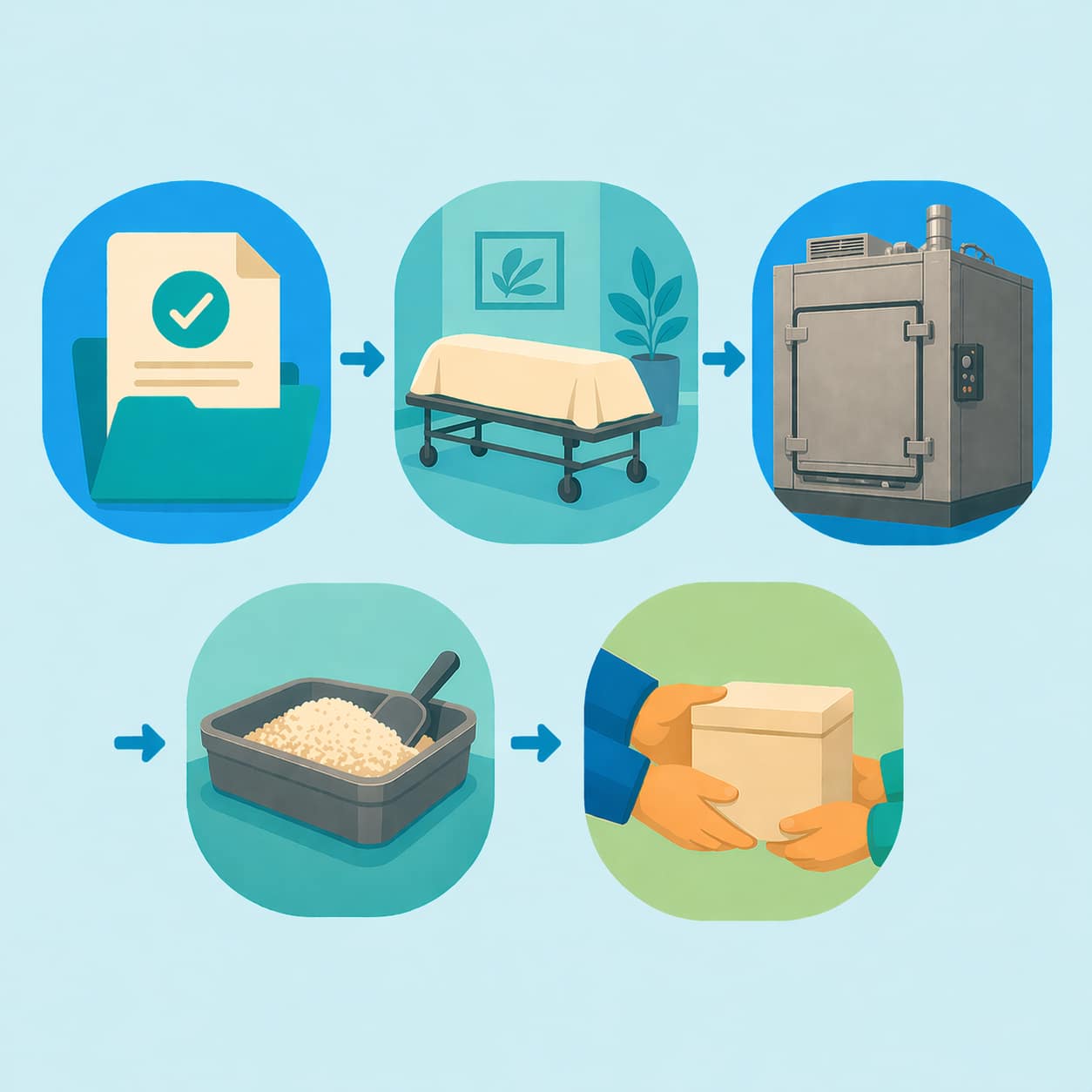
Before getting into the details, it helps to understand the big picture. Cremation is not just one step. It includes four main parts:
-
Transportation of the deceased
-
Secure storage before cremation
-
The cremation itself
-
Return of the cremated remains
When you’re comparing providers, it’s important to make sure all four of these elements are included and clearly explained.
Step 1: Transportation and identification
The process begins with transportation from the place of death to a funeral home or crematory. From that moment on, identification is a priority.
At each step, the identity of the deceased is confirmed and documented. This creates what’s known as a chain of custody, which tracks the remains from start to finish.
That chain typically includes checkpoints such as:
-
removal from the place of death
-
arrival at the funeral home or crematory
-
placement into storage
-
movement into the cremation chamber
-
processing and packaging of remains
-
return to the authorized individual
This documentation is one of the most important safeguards in the entire process.
Step 2: Storage before cremation
Cremation does not usually happen immediately. There is paperwork to complete, authorizations to obtain, and arrangements to finalize.
During this time, the deceased is placed in secure, temperature-controlled storage. The timing can vary depending on the situation, but cremation typically takes place at least 48 hours after death.
If the family chooses to have a viewing, visitation, or funeral service before cremation, those arrangements happen during this stage.
Step 3: Preparing for cremation
Before cremation begins, the body is placed in a cremation container. This container must meet certain requirements. It needs to be:
-
fully enclosed
-
rigid
-
leak-resistant
-
combustible
Families may choose anything from a simple alternative container to a casket, as long as it meets those requirements. Metal caskets cannot be cremated.
At this stage, identification is confirmed again. A unique identification number is assigned and typically placed on a durable metal disc. That disc stays with the remains throughout the entire process.
Step 4: The cremation itself
When everything is ready, the container is placed into the cremation chamber, often called a cremator.
The process is carefully monitored and typically takes between one and two hours for an adult, depending on factors like body size and the conditions of the chamber.
Inside the chamber:
-
soft tissues are reduced through heat and combustion
-
gases are processed through a secondary chamber
-
bone fragments remain in the primary chamber
Temperatures usually range between 1400 and 1600 degrees Fahrenheit, depending on the equipment and local regulations.
Once the process is complete, the remains are allowed to cool before the next step.
Step 5: Processing the remains
After cooling, the remaining bone fragments are collected and checked again for identification.
At this stage:
-
any metal, such as surgical implants, is removed
-
the remaining bone fragments are placed into a processor
-
the processor reduces them into a fine, consistent texture
This is what most people recognize as cremated remains.
The average weight of cremated remains for an adult is typically between four and six pounds.
Step 6: Returning the cremated remains
Once processing is complete, the cremated remains are placed into a bag and then into either:
-
the chosen urn, or
-
a temporary container if an urn has not yet been selected
The identification disc is placed with the remains, and all paperwork is checked again before release.
The remains are then returned to the authorized individual, often a family member or designated representative.
What can and cannot be cremated?
Families sometimes want to include personal items in the cremation. Some items may be allowed, but many are not.
Items that may be restricted include:
-
certain metals or batteries
-
pressurized containers
-
hazardous materials
Jewelry and personal items are often removed and returned to the family unless specific arrangements are made. It’s always best to ask the funeral director before including anything significant.
How do you know you receive the correct remains?
This is one of the most common concerns, and it’s a fair question.
The answer lies in the chain of custody. Every step of the process is documented, and identification is verified multiple times. The use of a unique identification number and physical tracking system ensures that the remains are accounted for from start to finish.
While procedures may vary slightly by location, the underlying goal is the same: accurate identification and careful handling at every stage.
Final thoughts
Cremation is a detailed and carefully managed process. While it may feel unfamiliar at first, each step is designed to ensure accuracy, safety, and respect.
Understanding how the process works can make a difficult time feel a little more manageable. It also helps families ask better questions and feel more confident in the decisions they are making.
Because in the end, this isn’t just about the process. It’s about trust.
