
 Buried in Work Staff
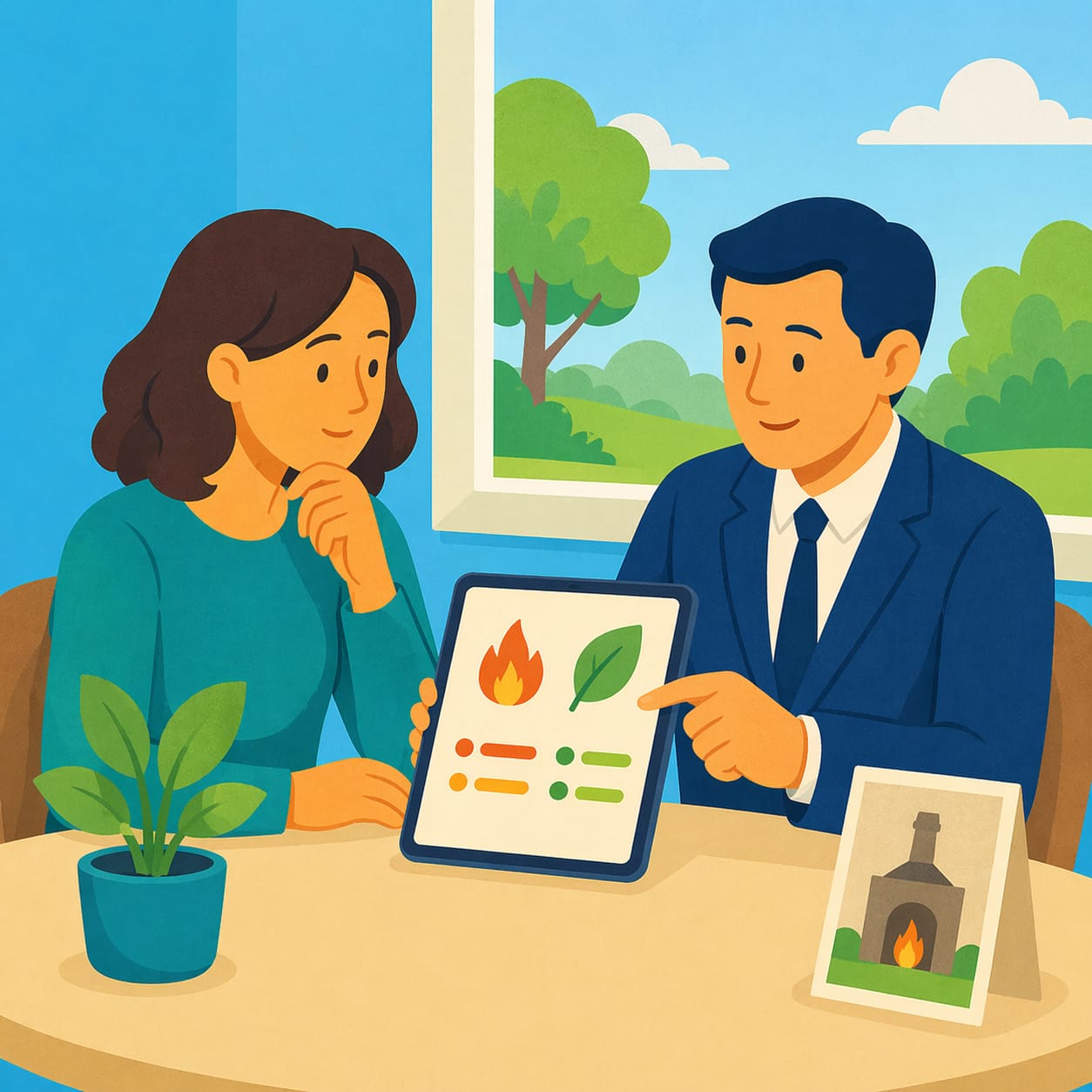
A lot of people assume cremation is the greener choice because it uses less land than burial. Others assume it must be harmful because it uses fuel and creates emissions. The honest answer is more nuanced than either of those extremes.
Cremation can be a practical and meaningful choice, but it is not impact-free. Like any form of disposition, it has environmental tradeoffs. If you are trying to make the most environmentally conscious decision possible, it helps to understand what cremation does, what affects its impact, and where the biggest variables really are.
The short answer: cremation is not impact-free
Traditional flame-based cremation uses heat, fuel, and combustion. That means it creates emissions. The U.S. Environmental Protection Agency identifies human cremation as a source of particulate matter, sulfur dioxide, nitrogen oxides, volatile organic compounds, carbon monoxide, and hazardous air pollutants. EPA also notes that human cremation is a significant source of mercury emissions, largely because of mercury in dental fillings.
So if the question is whether cremation is completely “green,” the answer is no.
But that still does not settle the larger question, because environmental impact is not just about one smokestack. It is about the whole process, the equipment being used, the materials involved, and what you are comparing cremation to.
Why the answer depends on what you mean by “environmentally friendly”
People usually mean one of three things when they ask this question:
-
Does cremation create air pollution?
-
Does cremation use a lot of fuel or energy?
-
Is cremation better or worse than other options like burial or water cremation?
Those are not the same question, and they do not always point to the same answer.
For example, cremation does avoid some impacts associated with conventional burial, such as long-term land use, casket manufacturing, vaults, and, in many cases, embalming chemicals. But it also creates combustion-related emissions that burial does not. That is why broad statements like “cremation is eco-friendly” or “cremation is terrible for the environment” usually oversimplify the issue.
What affects the environmental impact of cremation
Not every cremation has the same environmental profile. A number of factors can change the impact.
1. The age and efficiency of the cremator
Newer cremation equipment is generally built to meet more current emissions and performance standards. Older machines may be less efficient or less effective at managing combustion.
2. The fuel source and operating practices
Most crematories use natural gas. Fuel use can vary depending on the machine, maintenance, the number of cremations performed, and how efficiently the operation is run.
3. The body and what is placed with it
Cremation is not just about the body. It can also involve clothing, keepsakes, caskets or alternative containers, implants, dental work, and prosthetics. All of those can affect emissions or post-cremation handling.
4. Local air rules and permit requirements
Crematories are not unregulated. EPA’s emissions inventory and state air rules make clear that crematories are subject to environmental oversight, typically at the state and local level through permits and emissions standards. The details vary by jurisdiction, but the idea that crematories operate without regulation is simply wrong.
That means the environmental impact of cremation is partly about the process itself and partly about how well the facility is built, maintained, and regulated.
What actually comes out of a crematory
The public often focuses on visible smoke, but visible smoke is only part of the issue and often a sign of poor combustion or a problem worth investigating. Modern cremation equipment is designed to manage combustion as completely as possible, but complete combustion is not perfect in real life because there are so many variables involved.
EPA identifies human cremation emissions as including particulate matter, sulfur dioxide, nitrogen oxides, volatile organic compounds, carbon monoxide, and hazardous air pollutants. Mercury remains one of the biggest environmental concerns because dental amalgam can release mercury during cremation. EPA estimated that human cremation in 2020 resulted in approximately 2.3 tons of mercury emissions in the United States.
That is one reason some regions focus especially on mercury controls, while others focus more on different combustion pollutants.
Is cremation better than burial?
There is no universal winner in every category.
Conventional burial may involve land use, concrete vaults, casket materials, transportation, mowing and irrigation of cemetery grounds, and sometimes embalming chemicals. Cremation avoids some of those impacts, but adds fuel consumption and air emissions. Scholarly reviews of death-care sustainability generally treat this as a tradeoff question, not a simple right-or-wrong answer.
So if someone tells you cremation is always greener than burial, or always worse, they are leaving out important context.
What about water cremation?
If your goal is reducing combustion emissions, water cremation may be worth looking at.
Water cremation, also called alkaline hydrolysis, does not use flame. It uses water, alkaline chemicals, heat, and pressure to accelerate decomposition. CANA’s public materials note that many people choose it because they see it as more environmentally friendly and because it generally uses less fuel than flame-based cremation, though the exact footprint still depends on how you count water, energy, and chemicals.
That makes water cremation an appealing option for some environmentally focused families, but it is not available everywhere.
How to make cremation lower impact
If cremation is still the right fit for you or your family, there are ways to reduce its impact.
You can:
-
choose a provider with newer equipment and good maintenance practices
-
ask whether the crematory recycles metal after cremation
-
use a simple combustible container instead of a heavily finished casket
-
avoid unnecessary items in the container
-
consider water cremation if it is legal and available
-
think carefully about the memorial products you choose afterward
Those choices will not make cremation impact-free, but they can make it more intentional.
Final thoughts
Is cremation environmentally friendly? Not in the absolute sense. Traditional cremation uses fuel and creates emissions, and those impacts are real. But it also may avoid some of the material and land-use impacts associated with conventional burial. The better answer is that cremation is a tradeoff, not a clean environmental victory and not an environmental disaster by default.
For most families, the smartest approach is not to look for a perfect option. It is to understand the tradeoffs, ask better questions, and choose the path that best matches your values, priorities, and what is actually available where you live.
