
 Buried in Work Staff
Transporting cremated remains sounds simple until you start looking at the rules. Then you realize pretty quickly that the answer depends on how you’re traveling, where the remains are going, and whether you’re staying in the United States or crossing a border.
The good news is that it can be done. The better news is that it usually goes much more smoothly when you plan ahead.
Start with the first question: mail, air, or international?
Most people end up using one of three approaches:
-
shipping through USPS
-
carrying the remains on a plane or sending them by air cargo
-
arranging international transport
Each path has different rules, and those rules matter. This is one of those areas where guessing is a bad strategy.
Shipping cremated remains through USPS
If you are mailing cremated remains in the United States, there is one major rule to know right away. As of March 1, 2025, USPS requires mailers to use its special Priority Mail Express Cremated Remains Box, often called BOX-CRE, when shipping human or animal cremated remains domestically or internationally. That requirement replaced the older practice of using a regular box with Label 139 attached.
That applies not only to a full urn, but also to cremated remains in keepsakes or jewelry. USPS says domestic shipments must go by Priority Mail Express, and international shipments must go by Priority Mail Express International, assuming the destination country accepts that service and accepts cremated remains.
A few practical points matter here:
-
the inner container should be sealed and siftproof
-
the outer USPS cremated remains box must be used
-
extra services are limited, generally to insurance and return receipt
-
for international shipments, customs forms must identify the contents as cremated remains
So if you are mailing remains, the old advice to just label any sturdy box is no longer current.
Flying with cremated remains
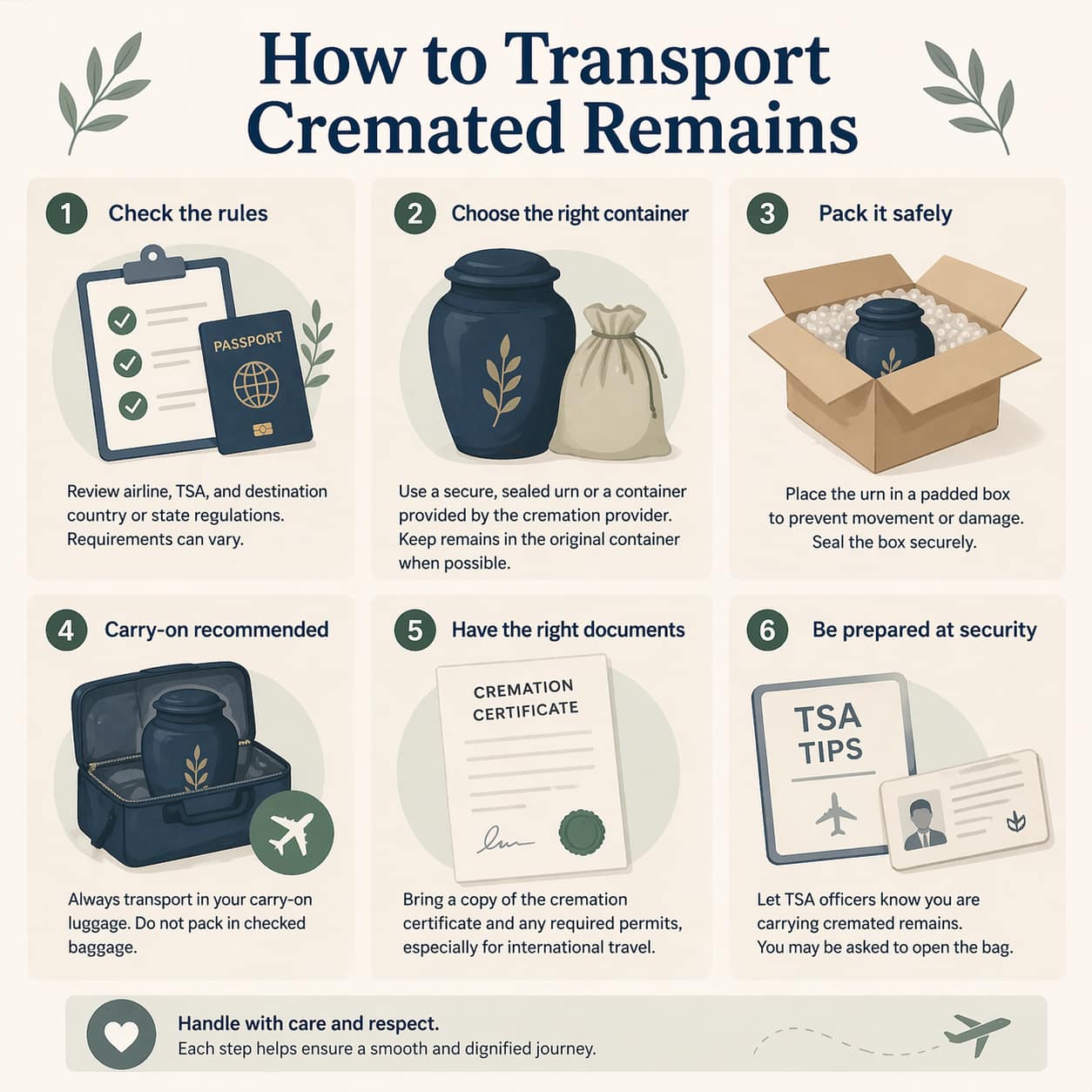
Many people prefer to travel with cremated remains themselves rather than ship them. That can work well, but there are two separate rule sets to think about: TSA and the airline.
TSA allows cremated remains through the checkpoint, but the container must be able to pass screening. If the container produces an opaque image and cannot be clearly screened, TSA says it will not allow the container through the checkpoint. TSA also notes that some airlines do not allow cremated remains in checked bags, so you should confirm the airline’s policy directly before you travel.
That means a few smart precautions:
-
use a container that can be X-rayed easily
-
call the airline ahead of time
-
arrive early
-
bring documentation with you
In practice, lightweight containers made of materials that screen well are often easier to travel with than heavy decorative urns. Even when the airline allows checked luggage, many families feel more comfortable keeping the remains with them rather than checking them.
What documents should you carry?
The exact paperwork can vary, especially for international travel, but it is wise to carry copies of:
-
the death certificate
-
the cremation certificate or certificate of cremation
-
any transit or authorization paperwork the provider gives you
For international transport, additional documents may be required, and some countries may want translations or consular paperwork. NFDA notes that some countries require documents accompanying cremated remains to be translated, and requirements can vary significantly by destination.
Even when you are staying domestic, having documentation with you can make airline, security, or receiving-party questions much easier to handle.
International transport takes more planning
Transporting cremated remains internationally is where things can get complicated quickly. The challenge is not just getting the remains out of one place. It is making sure the destination country will accept them and that you are following its rules.
USPS itself says mailers must verify that the destination country accepts Priority Mail Express International and accepts cremated remains before mailing.
Beyond that, country-specific rules may require:
-
special import or customs forms
-
consular involvement
-
use of a licensed funeral director
-
translated documents
-
cemetery or receiving-facility coordination
A good rule of thumb is this: if international transport is involved, start early and expect extra steps. Two weeks is a reasonable minimum planning cushion, and more is often better.
Don’t overlook the container itself
People naturally focus on paperwork, but the container matters too.
For mailing, USPS packaging rules control the outer box. For air travel, TSA screening requirements make the container choice especially important. A beautiful urn that cannot be screened may create problems at the airport, even if all of your paperwork is perfect.
That is why some families use a temporary travel-friendly container for transport and then transfer the cremated remains into a permanent urn later.
When a funeral director can save you a headache
This is one of those situations where professional help can be worth it. A licensed funeral director, crematory, or transport specialist can often help with:
-
paperwork
-
packaging
-
coordination with the receiving location
-
airline or shipping guidance
-
international requirements
That is especially true when the destination is overseas or the remains need to be sent to a cemetery, religious institution, or another provider.
A simple framework to keep in mind
If you want the shortest practical version:
-
Mailing in the U.S. means USPS Priority Mail Express with the required BOX-CRE packaging.
-
Flying with remains means checking both TSA and your airline, and using a container that can be screened.
-
International transport means checking the destination country’s rules before doing anything else.
Final thoughts
Transporting cremated remains is usually very manageable, but it is not something to do casually. The rules are specific for a reason, and a little planning goes a long way.
If you know how the remains will travel, what documents you need, and what the destination requires, the process becomes much less stressful. And at a time when families already have enough on their minds, that kind of clarity matters.
