
 Buried in Work Staff
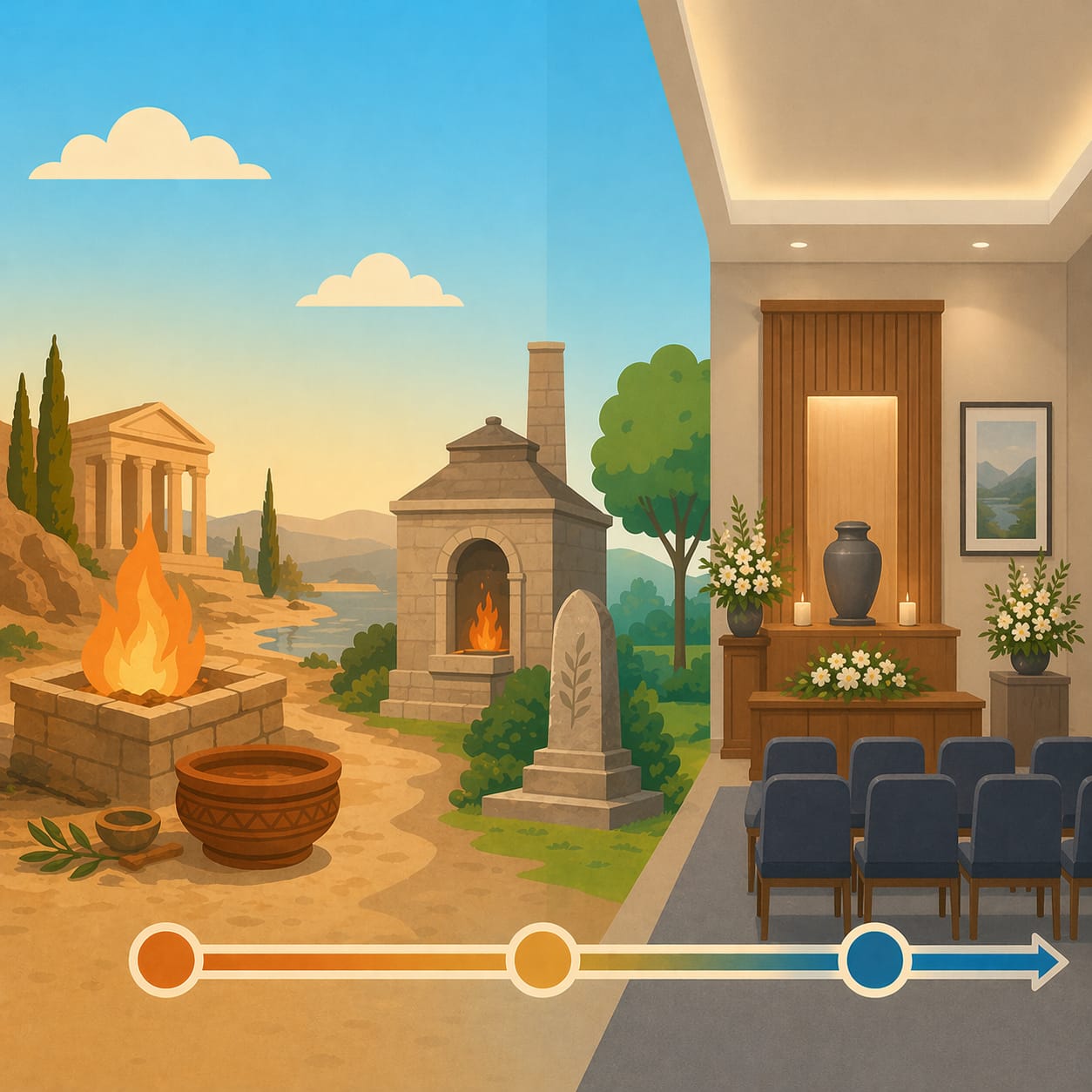
Cremation can feel like a modern choice, but it isn’t new at all. In fact, it’s one of the oldest known ways of handling the dead. What has changed over time isn’t the existence of cremation. It’s how people have understood it, accepted it, regulated it, and woven it into their cultural and religious traditions.
Looking at the history of cremation helps explain why it means different things to different people today. For some, it’s rooted in tradition. For others, it represents simplicity, flexibility, or personal choice. Both perspectives make more sense once you see the long history behind them.
Cremation in the ancient world
Scholars generally agree that cremation began in a meaningful way during the early Stone Age, around 3000 B.C., most likely in parts of Europe and the Near East.
From there, it spread across northern Europe. Archaeological discoveries, including decorative urns found in areas such as western Russia, show that cremation had become part of established burial customs in a number of early societies.
By the Bronze Age, cremation had moved into the British Isles and into parts of what are now Spain and Portugal. In some places, entire cemeteries were created for cremated remains. That tells us something important. Cremation wasn’t an isolated or unusual practice. It was organized, accepted, and woven into community life.
Greece and Rome helped shape early Western cremation
Cremation became especially prominent in ancient Greece. By around 1000 B.C., it had become part of Grecian burial customs, and by the time of Homer, it was a dominant method of disposition.
Part of that was practical. In a culture shaped by warfare, cremation allowed for quicker burial of slain warriors and was seen as a more expedient option in difficult conditions.
The Romans followed a similar path. By around 600 B.C., cremation was widely practiced, and during the Roman Empire it became common to place cremated remains in urns, often stored in structures similar to what we now call columbaria.
Even then, though, cremation wasn’t universal. Beliefs about the body, the afterlife, and religious identity were already influencing how different communities handled death.
Why cremation declined in Europe
By around 400 A.D., cremation had largely faded from use across much of Europe. As Christianity spread, burial became the preferred method of disposition. Cremation was often viewed as pagan or inconsistent with Christian beliefs about the body.
Jewish burial traditions also generally favored entombment or earth burial rather than cremation.
For the next 1,500 years, burial remained the accepted norm across most of Europe. Cremation still occurred occasionally during times of plague or war, but it was no longer the standard.
That long gap is one reason cremation can seem like a recent development today, even though its roots go back thousands of years.
Modern cremation started in the late 1800s
Cremation’s return in the modern era didn’t begin as a cultural revival. It began mostly as a practical and public health concern.
In 1873, Professor Ludovico Brunetti of Italy presented a dependable cremation chamber at the Vienna Exposition. That helped spark the modern cremation movement on both sides of the Atlantic.
In England, Sir Henry Thompson, a surgeon to Queen Victoria, became one of cremation’s leading early advocates. Concerned about sanitation and burial conditions, he helped found the Cremation Society of England in 1874. Soon after, the first modern crematories in Europe were built in Woking, England and Gotha, Germany.
Cremation in the United States and Canada
Modern cremation arrived in the United States soon after. In 1876, Dr. Francis Julius LeMoyne built the first modern crematory in Washington, Pennsylvania. The first cremation there, that of Baron dePalm, drew national attention and was attended by journalists and spectators from across the country.
From there, cremation began to spread slowly. By 1900, there were already 20 crematories operating in the United States.
In Canada, the first modern cremation took place at Mount Royal Cemetery in 1902.
Then, in 1913, Dr. Hugo Erichsen called a meeting of cremationists. That group would later become the Cremation Association of North America, better known as CANA. At the time, there were 52 crematories in North America and more than 10,000 cremations took place that year.
The 20th century changed everything
For much of the early 20th century, cremation remained relatively uncommon. But several major developments began to shift public opinion.
One of the biggest turning points came in 1963, when the Catholic Church lifted its ban on cremation. That change opened the door for millions of Catholic families who had previously ruled it out. While there were still conditions and preferences around funeral rites and final placement, the broader message was clear: cremation could now be part of Catholic practice.
That same year, Jessica Mitford published The American Way of Death, a widely influential critique of the funeral industry. The book increased consumer awareness and helped fuel calls for more oversight and transparency.
By 1973, the U.S. cremation rate had reached 5 percent. That may sound small now, but it marked a major shift after decades of slow adoption.
From reform to mainstream
As cremation became more common, the focus shifted from reform to standardization, regulation, and accessibility.
In 1975, the Cremation Association of America changed its name to the Cremation Association of North America to better reflect its membership in both the United States and Canada.
In 1984, the Federal Trade Commission introduced the Funeral Rule, which gave consumers important protections and pricing rights. That same general period also helped define and normalize direct cremation as an option.
CANA also played an important role in building industry standards, including operator training and model cremation laws.
By 1994, the cremation rate in the United States had reached 20 percent. By the late 1990s, there were nearly 1,500 crematories in the country and cremation accounted for more than a quarter of all deaths.
Why cremation kept growing
In recent decades, cremation has continued to grow for reasons that go beyond cost or simplicity. Today, personalization plays a huge role.
Families want more flexibility in how they gather, memorialize, and honor the person who died. Cremation makes that easier. It allows for services before or after cremation, more time for travel and planning, and a wider range of memorial choices.
Newer forms of disposition have also entered the conversation. Alkaline hydrolysis was first legalized in parts of the United States in 2009 as a form of cremation, and natural organic reduction began gaining legal recognition in some states starting in 2019.
By 2016, the cremation rate in the United States had passed 50 percent. In other words, cremation had moved from alternative to mainstream.
Where cremation stands today
Today, cremation is the most common form of disposition in many parts of the United States. What was once controversial or unfamiliar is now a standard choice for many families.
What makes cremation especially interesting now is how adaptable it has become. It can be simple or elaborate. Traditional or modern. Religious or secular. Public or private. That flexibility helps explain why it continues to grow.
And in 2026, modern cremation in the United States reaches an important milestone: 150 years since the first modern crematory was built and the first modern cremation was performed in 1876.
Final thoughts
The history of cremation isn’t a straight line. It’s a story of adoption, rejection, rediscovery, and change.
It began in the ancient world, disappeared for centuries across much of the West, then returned in the modern era through a mix of necessity, innovation, and changing values.
Understanding that history helps explain why cremation means different things to different people today. More than that, it reminds us that the way we care for the dead has always evolved along with the way we live, believe, and remember.
